Introduction
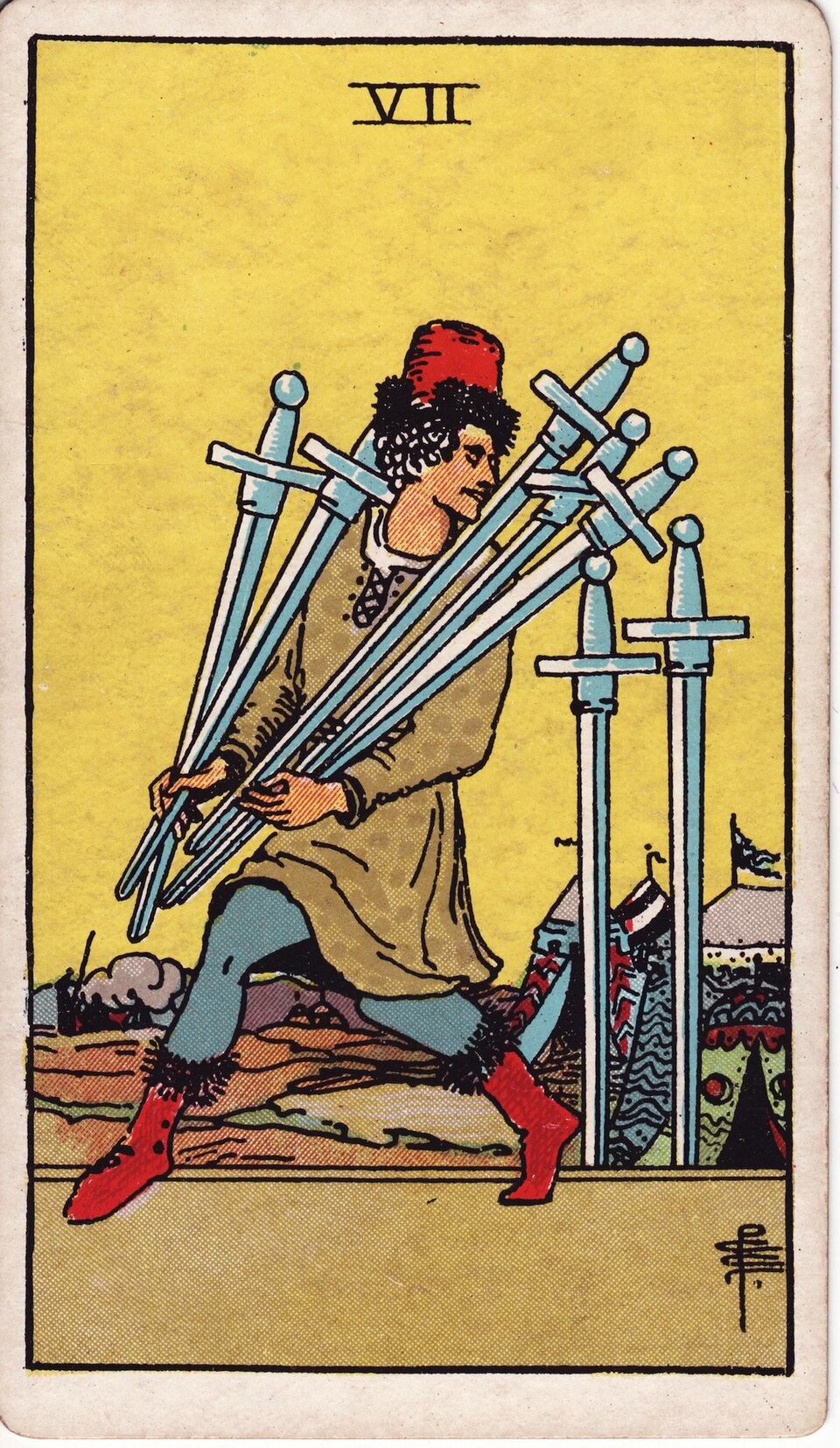
The Seven of Swords is strategy in the shadows: leaving camp with extra blades. It is cunning, privacy, or someone not telling the whole story—including you.
Upright meaning
Upright, it can describe a workaround, a discreet exit, or information handling. Ethics still apply. Not every secret is clever.
Reversed meaning
Reversed, a confession, getting caught, or dropping a scheme that was exhausting. Return what isn't yours.
Love
In love, omissions, a private plan, or testing. Trust is rebuilt with facts.
Career
At work, politics, IP caution, or a side path around a broken process. Document your own ethics.
General interpretation
The Seven of Swords is strategy in the shadows: leaving camp with extra blades. In a general reading, use the Seven of Swords to locate assessment and strategy under uncertainty, then check how thought, language, and conflict are behaving in the querent’s own account. Before borrowing the short phrase usually attached to the Seven of Swords, write the situation in your own plain words.
Symbolism
A figure looking back in many decks shows that the strategy has an audience, even if delayed.
Questions for reflection
- What am I not saying, and is the silence protective or evasive?
- Which problem needs a cleaner strategy rather than a sneakier one?
- If the Seven of Swords describes your current situation, what could you actually test before the week ends?
Related cards and spreads
FAQ
It can discuss concealment. Do not treat it as courtroom evidence.
Start from one visual detail in the Seven of Swords, write how it answers the question you asked, and set one small task to follow up. Do not treat the card as a command.
Sources and further reading
The Seven of Swords is shown here as drawn by Pamela Colman Smith for the 1909 Rider–Waite–Smith deck — public domain, via Wikimedia Commons. The suit’s wider tradition is described at Suit of Swords on Wikipedia. For the primary text behind the deck, see The Pictorial Key to the Tarot (1911, public domain).
These notes are cultural study material. They do not predict events, diagnose health, or replace professional advice.