Introduction
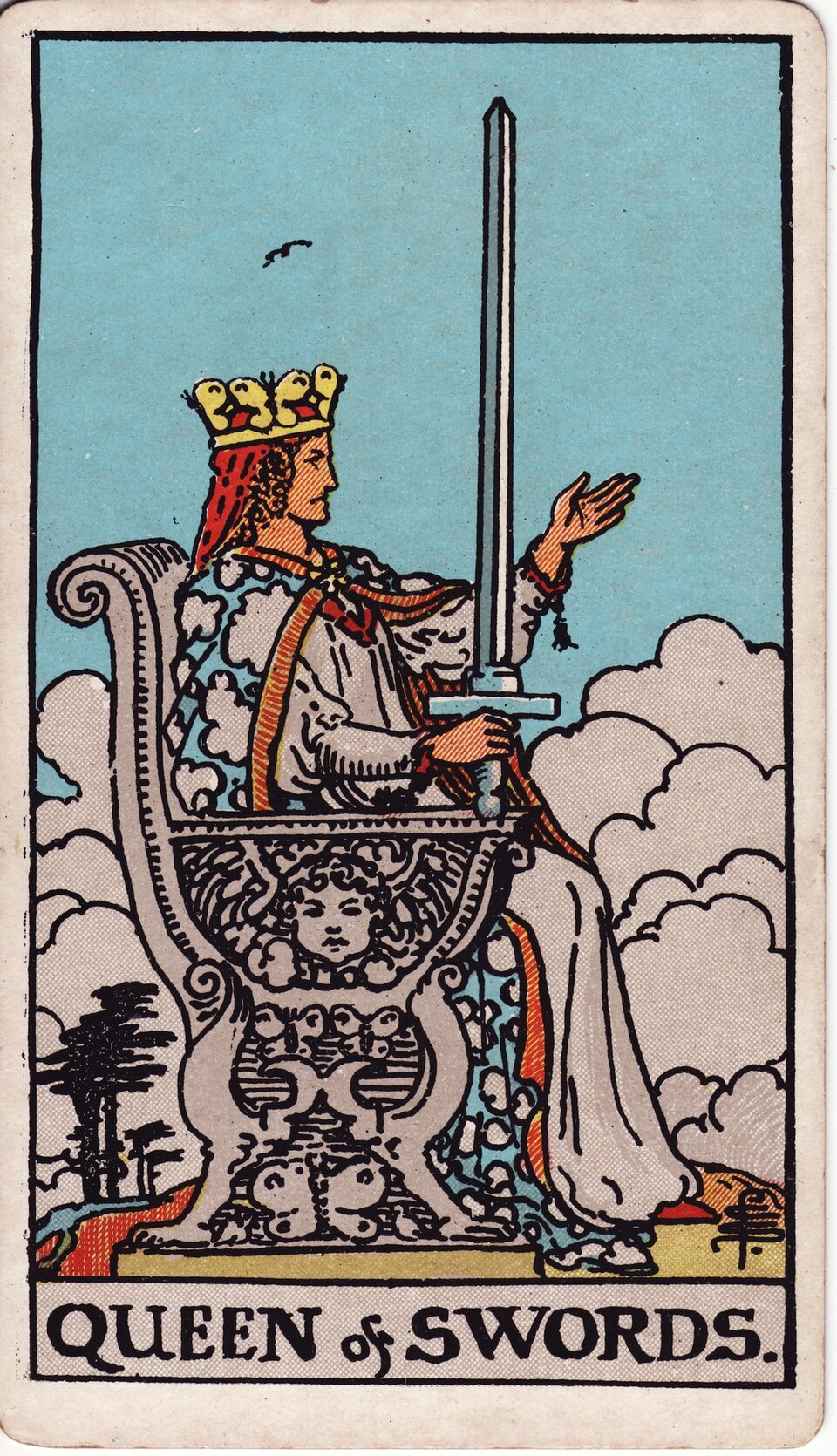
The Queen of Swords is practiced clarity: a raised blade, a hand extended, weather around a throne. She is honest, edited, and not interested in fog as a social lubricant.
Upright meaning
Upright, it can describe unbiased advice, widow/widower energy in older books (better read as independence), and language that is kind because it is exact.
Reversed meaning
Reversed, coldness, using wit to punish, or a mind that will not rest. Warmth is not the enemy of truth.
Love
In love, a partner who needs honesty first, or you asking for terms. Exactness can be intimate.
Career
At work, editing, law-adjacent thinking (not legal advice), analysis, and boundaries in communication.
General interpretation
The Queen of Swords is practiced clarity: a raised blade, a hand extended, weather around a throne. In a general reading, use the Queen of Swords to locate the steward’s stage, then check how thought, language, and conflict are behaving in the querent’s own account. Before borrowing the short phrase usually attached to the Queen of Swords, write the situation in your own plain words.
Symbolism
A raised hand in some decks is both greeting and halt: contact with conditions.
Questions for reflection
- What truth can be said with fewer adjectives?
- Where would precision be a form of care?
- If the Queen of Swords describes your current situation, what could you actually test before the week ends?
Related cards and spreads
FAQ
No. Many teachers read her as feeling that has been metabolized into language.
Start from one visual detail in the Queen of Swords, write how it answers the question you asked, and set one small task to follow up. Do not treat the card as a command.
Sources and further reading
The Queen of Swords is shown here as drawn by Pamela Colman Smith for the 1909 Rider–Waite–Smith deck — public domain, via Wikimedia Commons. The suit’s wider tradition is described at Suit of Swords on Wikipedia. For the primary text behind the deck, see The Pictorial Key to the Tarot (1911, public domain).
These notes are cultural study material. They do not predict events, diagnose health, or replace professional advice.