Introduction
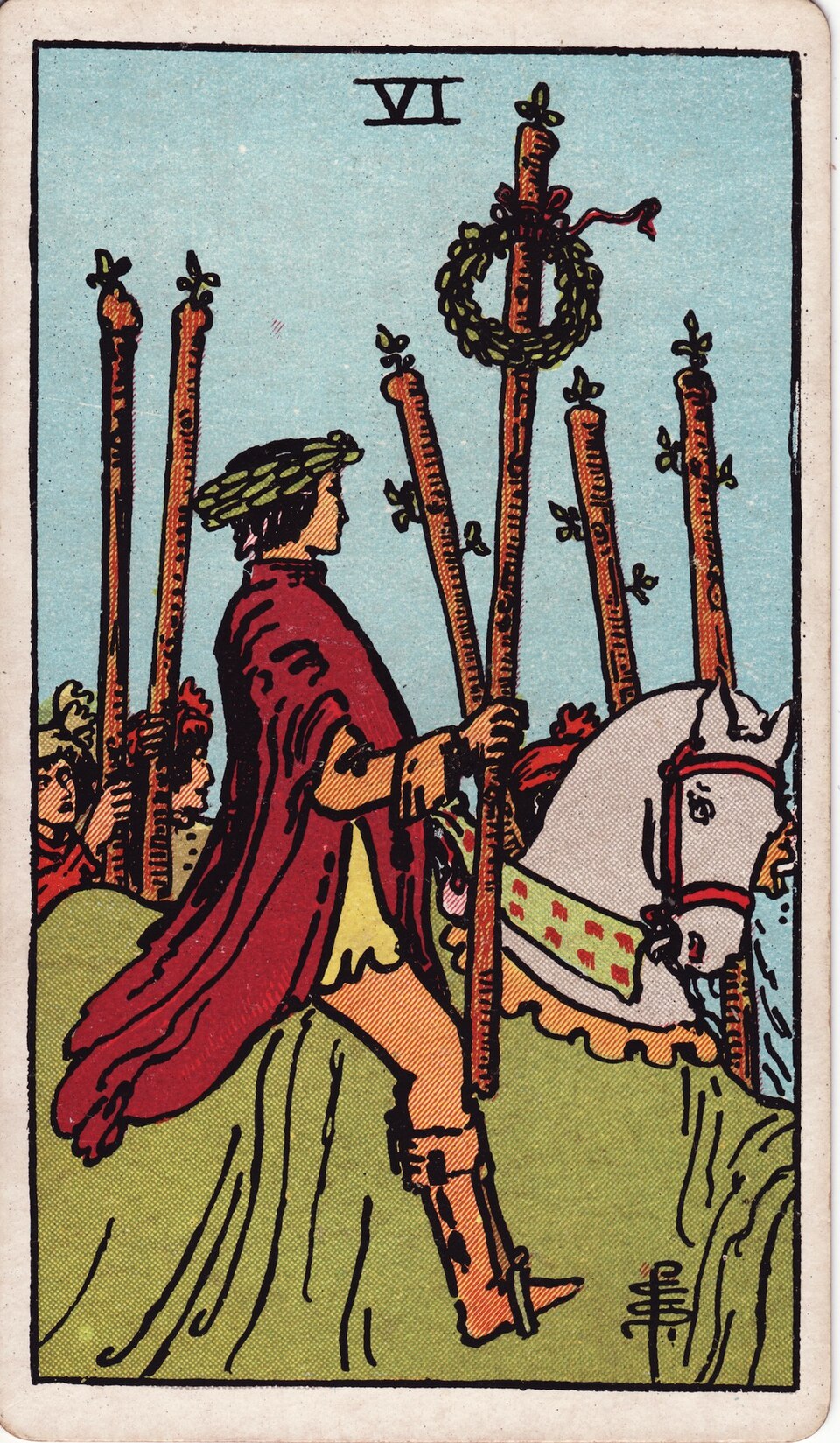
The Six of Wands is public recognition after a contest: a rider, a wreath, people alongside. It is success that can be seen, which also means it can be misread as identity.
Upright meaning
Upright, it can describe a win, a launch that landed, or being credited. Receive it, document it, then return to craft.
Reversed meaning
Reversed, delayed credit, fear of visibility, or a victory lap that forgot the team. Share the wreath or ask why it never arrives.
Love
In love, it can be pride in a partner or performing a couple for an audience. Ask who the success is for.
Career
At work, promotions, reviews, and case studies. Keep artifacts. Applause fades; a portfolio remains.
General interpretation
The Six of Wands is public recognition after a contest: a rider, a wreath, people alongside. In a general reading, use the Six of Wands to locate recovery, adjustment, or a return to something familiar, then check how drive, work, and initiative are behaving in the querent’s own account. Before borrowing the short phrase usually attached to the Six of Wands, write the situation in your own plain words.
Symbolism
A horse and wreath are images of movement plus honor, not of permanent ranking.
Questions for reflection
- What success needs to be recorded before I minimize it?
- Whose labor is missing from the victory story?
- If the Six of Wands describes your current situation, what could you actually test before the week ends?
Related cards and spreads
FAQ
It discusses recognition in context. It is not a celebrity forecast.
Start from one visual detail in the Six of Wands, write how it answers the question you asked, and set one small task to follow up. Do not treat the card as a command.
Sources and further reading
The Six of Wands is shown here as drawn by Pamela Colman Smith for the 1909 Rider–Waite–Smith deck — public domain, via Wikimedia Commons. The suit’s wider tradition is described at Suit of Wands on Wikipedia. For the primary text behind the deck, see The Pictorial Key to the Tarot (1911, public domain).
These notes are cultural study material. They do not predict events, diagnose health, or replace professional advice.