Introduction
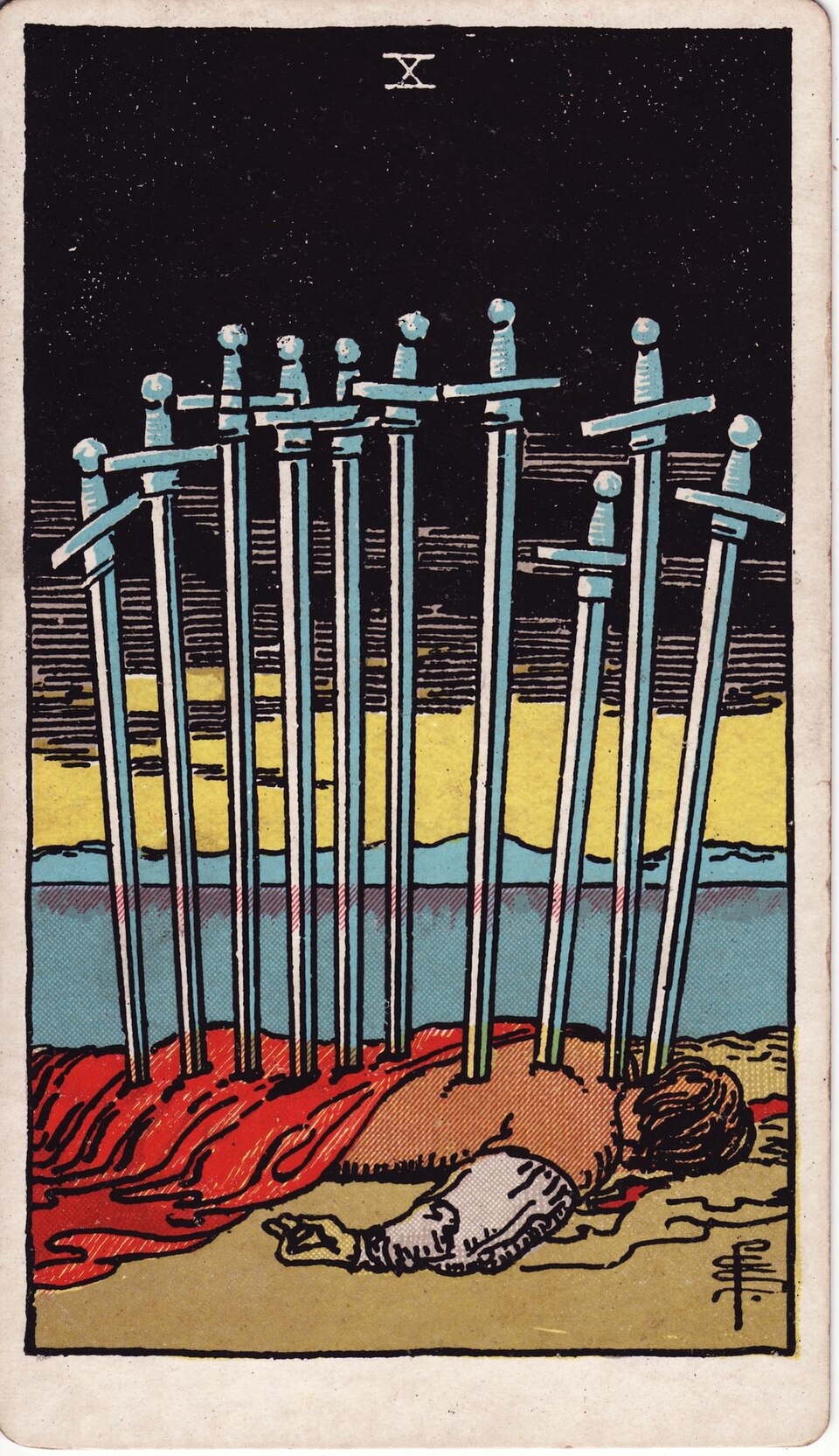
The Ten of Swords is an ending of a mental story: a figure down, many blades, a dawn at the horizon in many decks. It is overkill, rock bottom of a narrative, and the possibility of a new morning.
Upright meaning
Upright, it can describe a chapter that cannot be spun anymore, betrayal of an idea, or exhaustion of a strategy. Stop adding swords. The point is already made.
Reversed meaning
Reversed, recovering, or refusing to admit an ending. Let the sun be a sun, not a speech.
Love
In love, a painful conclusion or a story about someone that has died. Grief is valid. So is not rewriting history to keep a plot.
Career
At work, a project killed, a layoff theme, or a method that failed. Archive and rest.
General interpretation
The Ten of Swords is an ending of a mental story: a figure down, many blades, a dawn at the horizon in many decks. In a general reading, use the Ten of Swords to locate completion, and what the result hands over to the next round, then check how thought, language, and conflict are behaving in the querent’s own account. Before borrowing the short phrase usually attached to the Ten of Swords, write the situation in your own plain words.
Symbolism
Dawn on the horizon is the teaching that endings occur in a continuing world. This is not a physical-death card.
Questions for reflection
- What story is over, even if I keep narrating it?
- What would a humane ending look like?
- If the Ten of Swords describes your current situation, what could you actually test before the week ends?
Related cards and spreads
FAQ
It can describe a harsh ending of a situation or idea. It is not a curse and not a medical omen.
Start from one visual detail in the Ten of Swords, write how it answers the question you asked, and set one small task to follow up. Do not treat the card as a command.
Sources and further reading
The Ten of Swords is shown here as drawn by Pamela Colman Smith for the 1909 Rider–Waite–Smith deck — public domain, via Wikimedia Commons. The suit’s wider tradition is described at Suit of Swords on Wikipedia. For the primary text behind the deck, see The Pictorial Key to the Tarot (1911, public domain).
These notes are cultural study material. They do not predict events, diagnose health, or replace professional advice.