Introduction
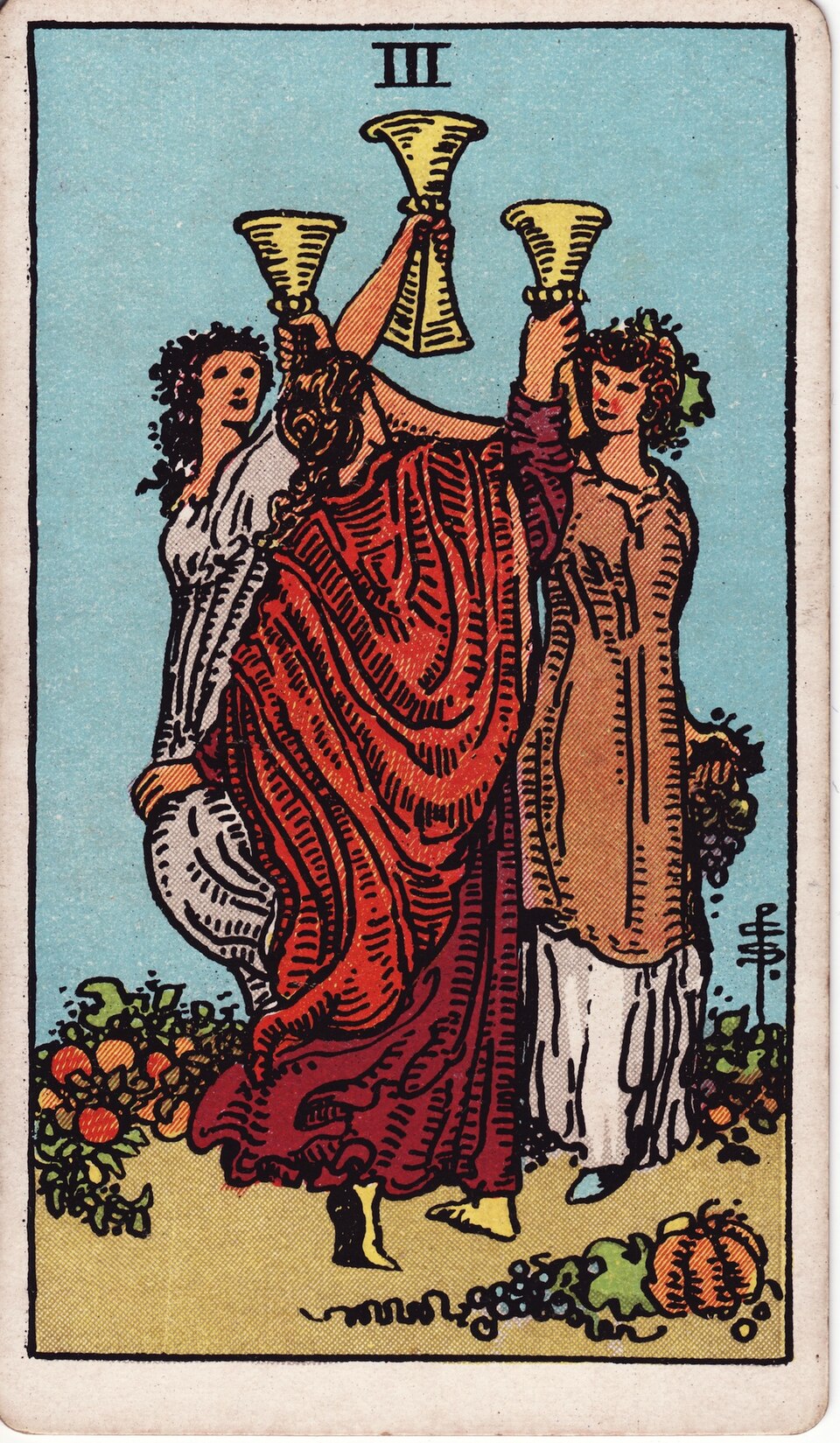
The Three of Cups is shared joy: friendship, a table, a chorus rather than a duet. It is celebration that does not need a hierarchy.
Upright meaning
Upright, it can describe found family, a team win, or taking a problem back to community. Let other people in on the good news.
Reversed meaning
Reversed, gossip, a group that excludes, or isolation after the party. Choose smaller, kinder rooms.
Love
In love, friends as witnesses, a triad of support, or a relationship that is healthier with community around it. It is not automatically infidelity.
Career
At work, morale, launch parties, and collaboration that is actually fun. Culture shows in who gets invited.
General interpretation
The Three of Cups is shared joy: friendship, a table, a chorus rather than a duet. In a general reading, the Three of Cups sits at the point where a private matter starts to involve others: the practical question is how feeling, connection, and inner life are doing at that point in the story. Write what is happening in ordinary language first; the standard one-line reading of the Three of Cups will fit better afterwards.
Symbolism
Raised cups are a study image of toasting: name what you are toasting.
Questions for reflection
- Who belongs at this table, and who is missing?
- What celebration would restore perspective?
- Which three-day action would tell you whether the message of the Three of Cups is real in your case?
Related cards and spreads
FAQ
Sometimes readers discuss triangulation, but the primary teaching is friendship and shared joy. Context matters; do not accuse.
Pick one drawn detail from the Three of Cups, note how it bears on your question, and finish by choosing one modest action. Do not treat the card as a command.
Sources and further reading
The Three of Cups appears here in the 1909 Rider–Waite–Smith drawing by Pamela Colman Smith, public domain, via the Wikimedia Commons collection of the deck. The suit’s background is covered at Suit of Cups on Wikipedia. Waite’s period commentary on this part of the deck is in The Pictorial Key to the Tarot (1911, public domain).
These notes are cultural study material. They do not predict events, diagnose health, or replace professional advice.