Introduction
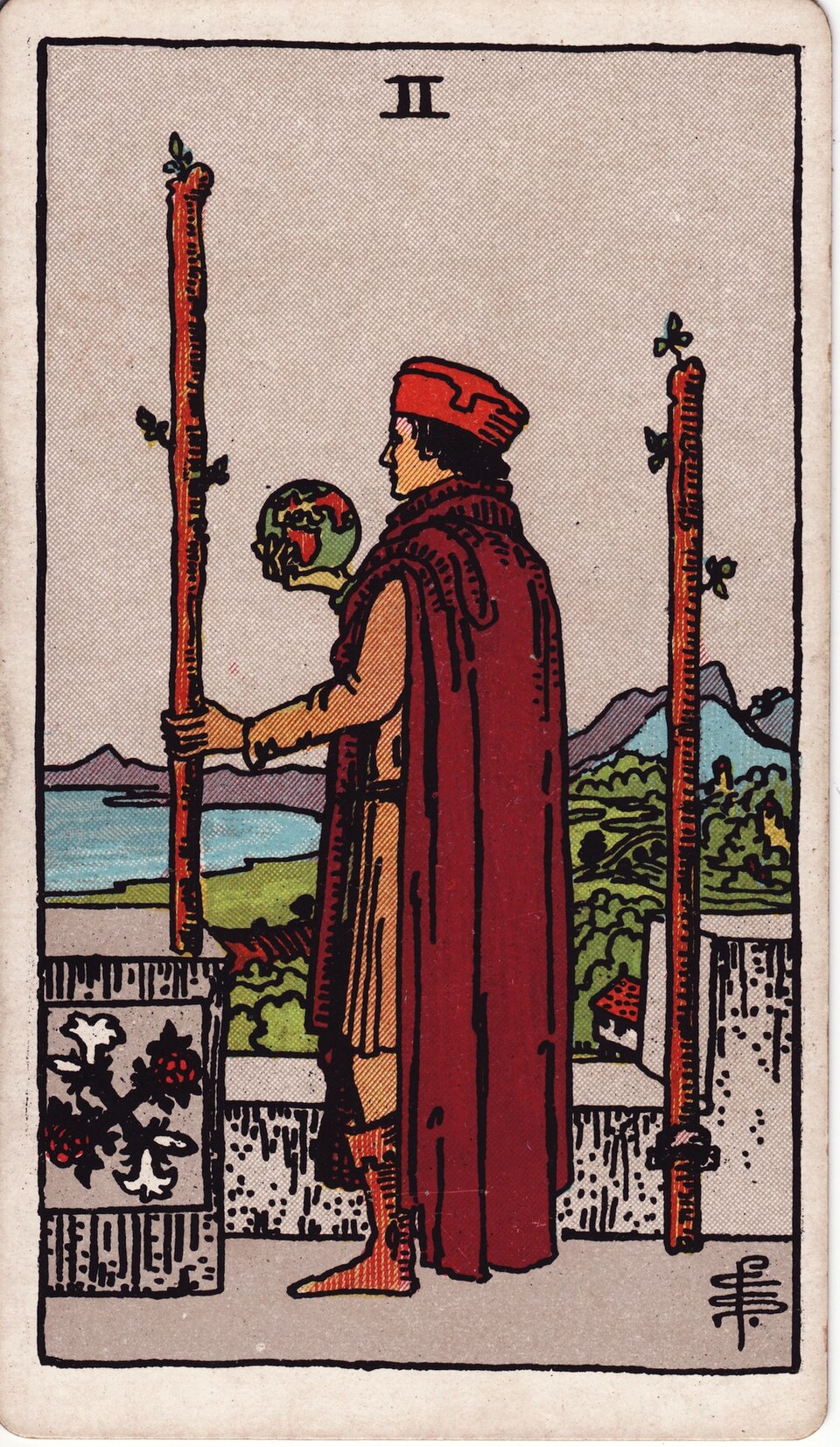
The Two of Wands is planning heat: a globe in the hand, a second wand standing still. It is the moment after the spark when you look at the horizon and choose a direction.
Upright meaning
Upright, it can describe strategy, travel of ideas, and comparing a current world with a possible one. It favors maps and conversations with people who have walked a path.
Reversed meaning
Reversed, plans stall in daydream, or fear of leaving a familiar room. Shrink the horizon to a ninety-day sketch.
Love
In love, it can be deciding whether to invest, or imagining a shared future too early. Ask what has actually been agreed.
Career
Career-wise, it is a planning-board card: markets, locations, collaborators. Look at risk without pretending you already live in the future.
General interpretation
The Two of Wands is planning heat: a globe in the hand, a second wand standing still. Read generally, the Two of Wands marks a first decision or exchange — a good moment to ask what drive, work, and initiative actually need, rather than what a keyword list suggests. State the situation in plain sentences, then let the usual shorthand for the Two of Wands refine it rather than replace it.
Symbolism
A figure between a castle wall and an open view often shows the tension of leaving a known structure.
Questions for reflection
- What decision would turn this from a mood into a plan?
- Whose map am I using, and does it fit my terrain?
- What small, checkable step would honour the Two of Wands within the next three days?
Related cards and spreads
FAQ
It can discuss looking farther afield, but it is not a relocation forecast.
Describe a single detail you notice in the Two of Wands, connect it to your question in a line or two, and close the entry with a next step. Do not treat the card as a command.
Sources and further reading
The image above is the Two of Wands from the 1909 Rider–Waite–Smith deck, drawn by Pamela Colman Smith (public domain, via Wikimedia Commons). Background on the suit is collected at Suit of Wands on Wikipedia. A period commentary on the cards, The Pictorial Key to the Tarot (1911, public domain), is available in full at Wikisource.
These notes are cultural study material. They do not predict events, diagnose health, or replace professional advice.